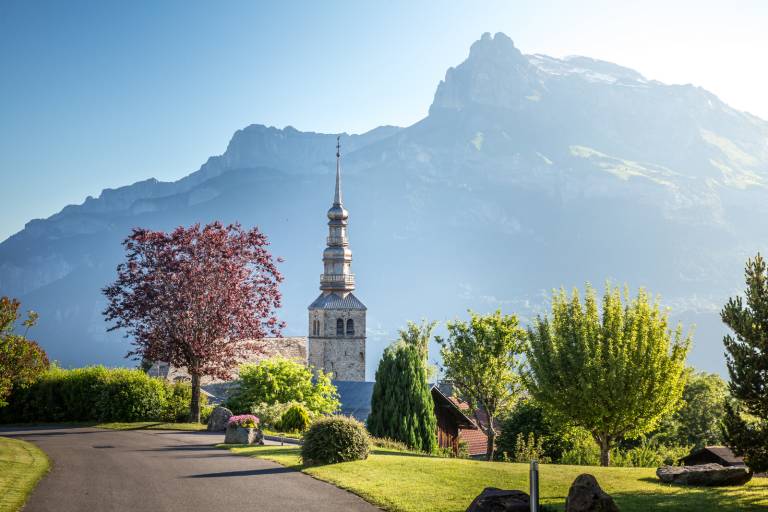
Saint Nicolas baroque church


Description
Built in the early 18th century, the Church of Saint-Nicolas is a prime example of Baroque art in Combloux. Its double-bulb bell tower, polychrome altarpiece, and antique sundial make it a key part of the local heritage.
➡️ A church rebuilt in the early 18th century
The Church of Saint-Nicolas in Combloux was rebuilt between 1702 and 1704 on the site of an older religious building dating back to the 15th century. It is dedicated to Saint Nicholas, the patron saint of children, merchants, and boatmen.
His legend can still be seen today beneath the church’s entrance canopy, depicted in frescoes that recount various episodes of his life.
➡️ A bell tower emblematic of Savoyard onion-dome architecture
The current bell tower, rebuilt in 1828 following destruction during the Revolution, stands approximately 45 meters tall. Its silhouette—featuring a double onion dome and double octagonal gallery, topped by a cross and a weathercock—makes it one of the village's most recognizable landmarks.
It has been listed as a Historical Monument since 1971 and stands as a remarkable example of Savoyard onion-dome architecture.
➡️ Inside: the richness of the Baroque style
Inside, the eye is drawn to the central polychrome carved-wood altarpiece, which embodies the Baroque taste for color, gilding, intricate carvings, and twisted columns. This altarpiece is also classified as a Historical Monument.
The church houses several other notable features, including stained-glass windows, paintings, an organ brought from Nevers Cathedral, and numerous decorative details that showcase the richness of Alpine religious art.
➡️ An ancient sundial
The façade also features a sundial reputed to be the oldest in the Mont Blanc region.
Along with the monumental granite doorway, it is a highlight to admire before even stepping inside the church.
➡️ Good to know before your visit
The church is open to the public free of charge all year round.
Guided tours of the Church of Saint-Nicolas are organized during school holidays, offering the chance to discover its history, architecture, and the key characteristics of Baroque art in the company of a heritage guide.
Princing
Free access.